
Penfield Historical Directory Collections
Penfield has no single townwide historical directory run. The useful shelf is spread across Rochester Public Library, its digital collections, and the Town of Penfield's Local History Room. The regional material must be read carefully: a Rochester volume can be valuable context, while a suburban volume proves a Penfield listing only after the actual book and street are checked. Start with the collection that matches the year and the kind of lead, whether name-first, address-first, or local-family research.
| Collection | Years | Where Held | Access |
|---|---|---|---|
| Rochester city directories, existing volumes | 1827-1946 | Rochester Public Library digital collection and NY Heritage | Digitized volumes; confirm Penfield title and coverage |
| Rochester House Directory supplements | 1892-1920 | Rochester Public Library | Penfield street-address occupant research |
| Later Rochester main-directory house sections | Circa 1922/1924 onward in the main volumes | Rochester Public Library | Check Penfield entries in the selected book's back matter |
| Suburban directories | 1930-1940 | Rochester Public Library | Inspect the actual volume before claiming Penfield coverage |
| Local family and property files | Dates vary | Penfield Local History Room | Appointment and seasonal-hours route |
The online run does not make every Penfield year, suburb, or street searchable. A Penfield no-hit means only that the checked volume did not supply a hit. Record whether the volume covers the street, whether Penfield town coverage is unverified, whether no pre-1892 house directory exists, or whether the volume has not yet been searched.
Penfield Directory Research at Local History
The Penfield Local History Room is the local fallback when digitization ends or an entry needs context. Its holdings include census material, cemetery and church records, birth, death, and marriage listings, family and property files, clippings, maps, directories, tax material, yearbooks, and reference books. The room is at the Community Center and library setting on Baird Road, and its research route is appointment-based because hours can vary seasonally.
The Local History Room began in 1984 and is especially useful for resolving a Penfield surname, farm, home, organization, or historic locality after a directory entry is found. The Penfield Town Historian identifies an appointment-based research route, rather than an all-purpose online index. That division matters: a Penfield directory can give a printed lead, while the room may supply the period map, clipping, or family file needed to judge the lead.
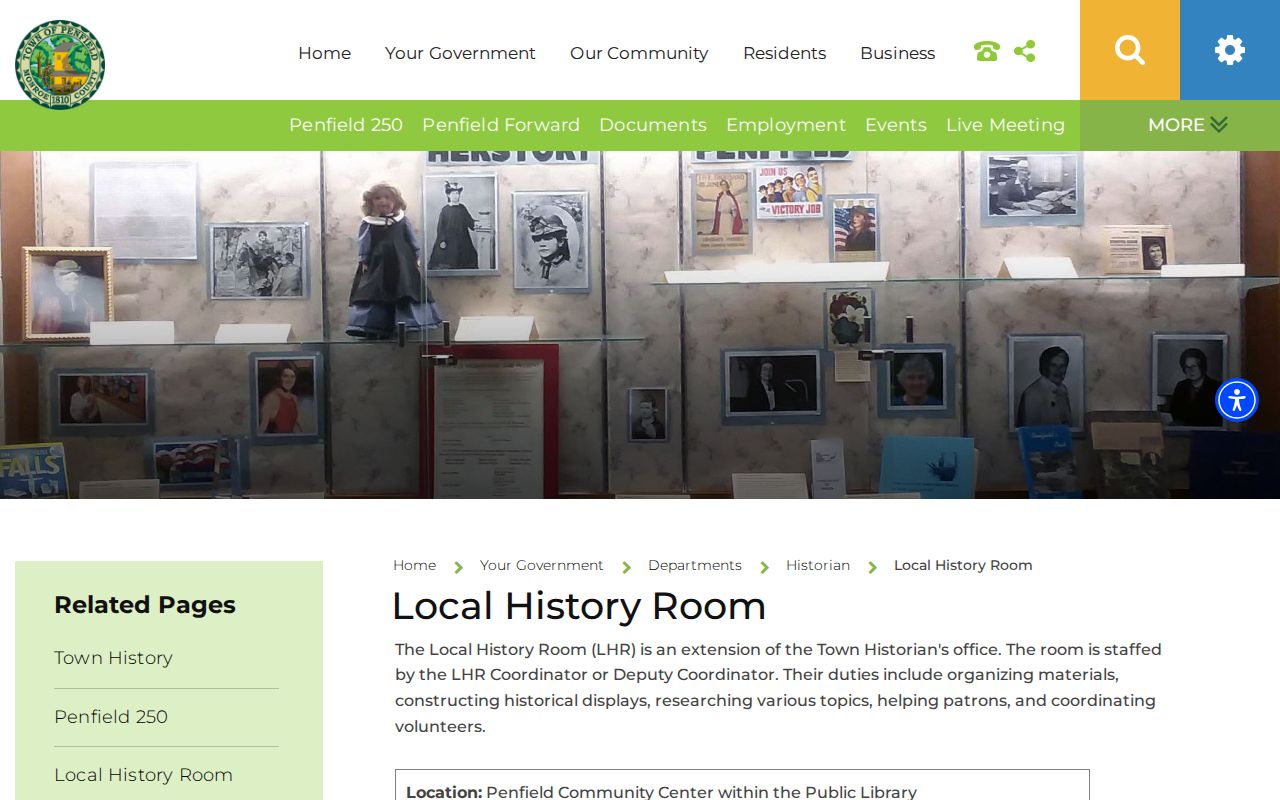
The Penfield Local History Room collection page shows the Penfield genealogy and directory setting used for this research.
Use the room to bridge a missing Penfield digital year, not to assume that a Penfield file proves a current household or a complete townwide listing.
Penfield Directory Years Online
Rochester Public Library's digitized directory collection makes existing Rochester directories available through 1946. The original city-directory sequence begins in 1827. These books can support Penfield name, business, street, and later house-section work, but they are not a promise that each volume includes Penfield. Preserve the Penfield directory title, year, edition, page, printed town or city label, and the placement of the entry before comparing it with any other source.
NY Heritage also hosts the established Rochester collection. Digital access is a strong starting point for Penfield research, but physical or library-held Penfield reference material still fills gaps. A listing could be an occupant, owner, business, boarder, company, or the closest numbered entry. The label in the book controls the Penfield claim.
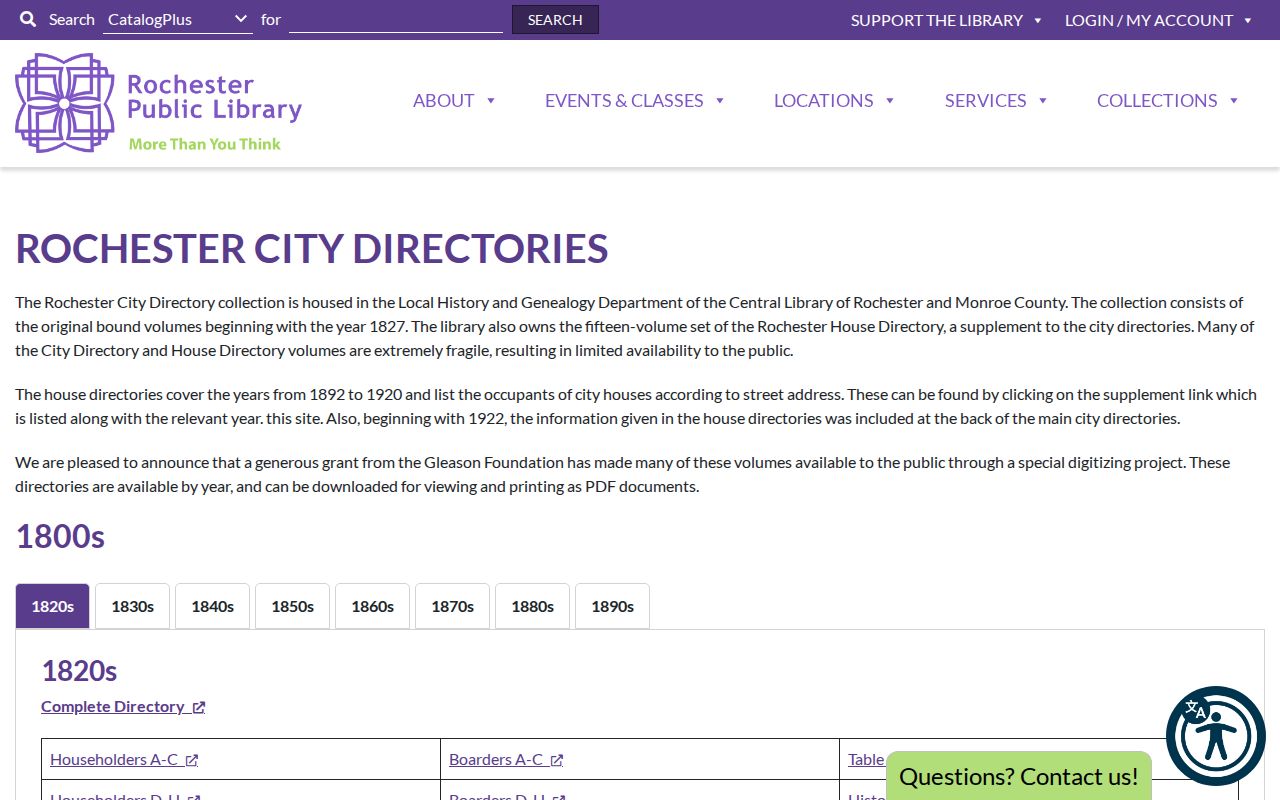
The digitized Rochester city-directory collection provides a useful Penfield year and title selector before a volume-level check.
Save the Penfield page image or PDF location with the citation so a reader can distinguish a direct entry from a later interpretation.
Penfield House Directory Listings
The Rochester House Directory supplements are the clearest address-first resource identified for Penfield research from 1892 through 1920. They list occupants by street address, making them different from a surname directory. No house directory before 1892 was identified in the Rochester Public Library house-history guidance. For later years, house information moved into the back sections of main directories around the 1922/1924 period. Check the selected book used for a Penfield search because title and layout can change.
Begin with the Penfield address as printed, including suffix and direction. If pagination or abbreviations hide the number, inspect adjacent entries for the Penfield street. Keep the historic spelling and address form instead of updating them silently. A number that fails to match a modern Penfield parcel should be treated as an unresolved historical-address question, not forced into a current address.
Note: The house-history guidance warns that both city borders and house numbers can change, so a modern Penfield map alone cannot validate an older listing.
Reading a Penfield Directory Entry
A Penfield city directory entry is a dated lead, not a modern profile. The research did not establish one universal printed shorthand or owner mark across all Rochester volumes, so the abbreviation key in the exact book for Penfield research should govern every transcription. Record only fields that are actually printed. An occupation or business line can help separate same-name people in Penfield research, but it should remain tied to the source and should not be used to make a present-day claim.
| Printed name | Transcribe initials, spelling, and any household or company wording exactly as shown. |
|---|---|
| Address line | Keep the number in the Penfield address, street suffix, direction, and locality in the form printed in the volume. |
| Directory citation | Save the title for the Penfield search, year, volume or edition, page, collection, and image or PDF location. |
| Placement | Identify whether it appears in a name directory, street directory, house section, business listing, or advertisement. |
| Context line | Note an occupation, business, or household indicator only when the book prints it and it helps distinguish the historical entry. |
| Next check | List the census, cemetery, church, newspaper, deed, map, or local file for Penfield needed to test the match. |
- Criss-cross directory
- A directory arranged by street or address rather than by surname. In Penfield research, the Rochester house directories and later house sections serve that address-first purpose.
- Householder index
- A name-oriented index to a Penfield household or address listing, when the selected volume supplies one.
- Abbreviation key
- The selected Penfield volume's own explanation of shortened labels. Photograph or cite it before expanding a mark in an entry.
Penfield Directories and Boundaries
The 1930-1940 suburban volumes offer a regional cross-check, not automatic Penfield coverage. The displayed runs emphasize Brighton, Gates, Greece, Irondequoit, Pittsford, East Rochester, Fairport, and Webster. A Penfield search should therefore say "volume exists but town coverage unverified" until the actual title, street, and page are inspected. That caution avoids turning a nearby-suburb resource into a false Penfield finding.
Place names need the same care. Township 14 became Webster in 1840, so older records described as Penfield can map to a different present municipality. Four Corners was a Penfield business and residential center at Five Mile Line Road and Penfield Road, but it was never an incorporated village. Preserve the historic locality, modern jurisdiction note, and source date as separate facts.
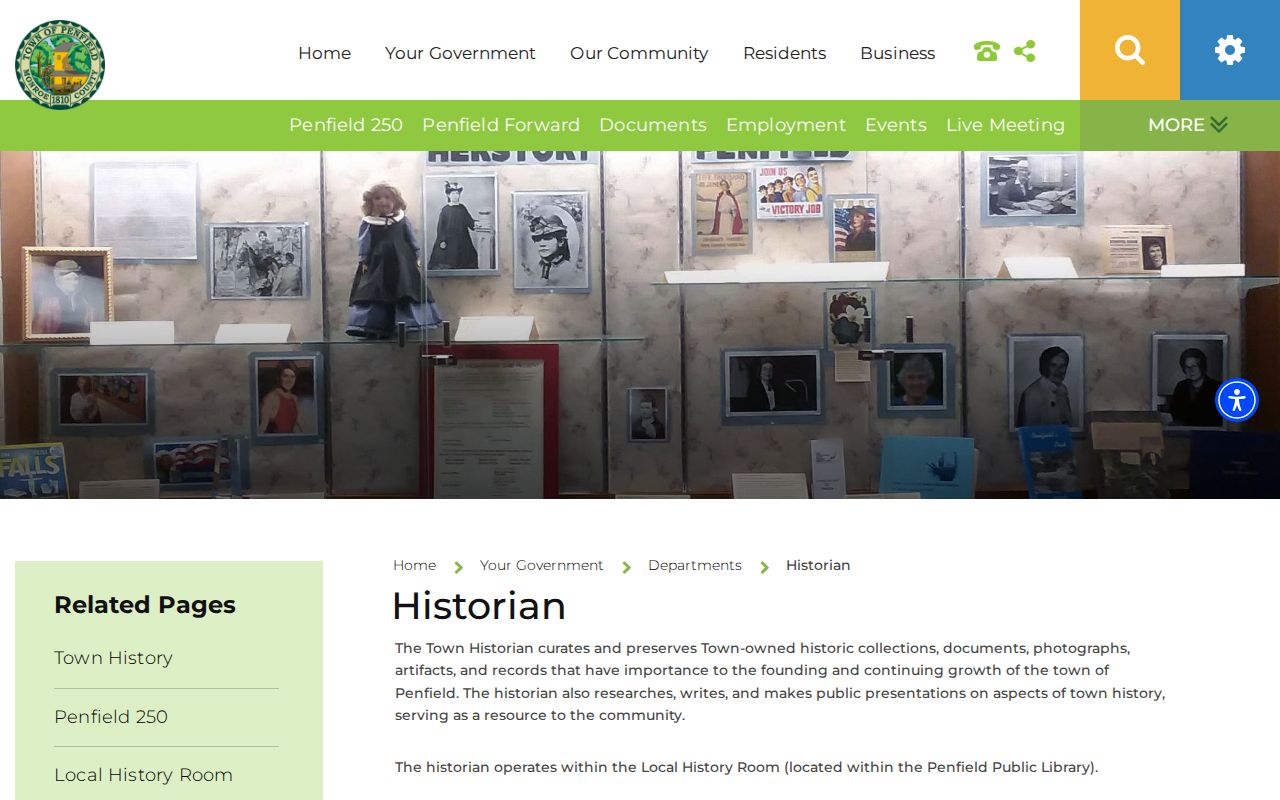
The Town Historian route is the appropriate local contact when a boundary question or old locality needs more than a directory citation can answer.
Historical geography can explain a mismatch, but it never substitutes for checking the exact volume and the custodian's supporting records.
Penfield Directory Cross-Checks
Pair a Penfield directory year with a source that has its own date and purpose. Federal census schedules follow a 72-year public-release rule, so the 1950 census is public while later schedules remain closed. The Penfield Local History Room also holds census, cemetery, church, family, and newspaper material. Use those sources to test Penfield continuity, not to turn a single dated listing into a claim of current residence.
Penfield Smith Cemetery material illustrates the source ladder. Its transcription was copied in May 1991, while the research notes that official burial records begin on April 25, 1901 and that originals were associated with the Penfield Town Clerk, with a copy at the Penfield Local History Room. The transcription omits cause-of-death and undertaker details. Use it for Penfield discovery, then seek the original or custodial copy for verification.
Rochester Public Library's Local History and Genealogy resources add Penfield clipping files, a nineteenth-century newspaper index, census microfilm, and manuscript collections. An exact standalone Penfield obituary-index title and coverage were not located, so a Penfield search request should name the clipping or newspaper route rather than promise an index that has not been verified.
Tracing Penfield Directory Households
Trace one Penfield household in sequence, and keep each result in its proper role. The aim is a dated Penfield research trail, not a combined list of people. A disappearance can mean a move, a death, a different spelling, an omitted suburb, a changed number, or a volume that does not cover the place. Test those Penfield possibilities before drawing any conclusion.
- Choose a Penfield directory year and search the name in the form likely to appear in that period.
- Record the printed Penfield address, page, title, edition, and whether the entry sits in a name, business, or street section.
- Move one directory year backward and forward within the Penfield run, writing down each change in spelling, address, or placement.
- For Penfield research from 1892 through 1920, check the house-directory supplement; for later periods, inspect the main volume's back sections.
- Compare the dated Penfield trail with a census, cemetery or church record, local clipping, deed, or Local History Room file.
- Mark the result as exact source match, strong cross-source match, probable, ambiguous, or not a match.
For a current Penfield parcel question, use the modern address-record route rather than asking an old book to prove present occupancy. The dated Penfield historical shelf remains useful for family history, property history, and original place-name research.
Note: A Penfield directory no-hit is informative only when the selected volume is known to cover the relevant street and year.